How Tech Will Change Workplaces
Created on 12 January, 2026 • Tech Blog • 329 views • 11 minutes read
How technology will change workplaces in 2026: Explore the rise of sentient offices, agentic AI coworkers, spatial computing, and biometric wellness.
The Architectural Shift: How Technology Will Redefine Workplaces in 2026
Table of Contents
The Sentient Office: Beyond Smart Buildings
Agentic AI: The Emergence of the Synthetic Coworker
Spatial Computing and the Death of the 2D Desktop
The Hyper-Personalized Employee Experience
Algorithmic Management and the Future of Leadership
Biometric Wellness and the Quantified Professional
The Decentralized Talent Cloud and Borderless Collaboration
Predictive Maintenance for Human Productivity
The Ethics of the Digital Panopticon
Conclusion: Engineering a Human-Centric Future
The Sentient Office: Beyond Smart Buildings
As we enter 2026, the concept of the workplace has transcended the physical boundaries of a mere office building. We are witnessing the rise of the sentient office, an environment that does not just house employees but actively interacts with them. In this new reality, the workplace is an integrated ecosystem of sensors, AI, and responsive materials that adjust in real-time to the needs of the workforce. Gone are the days of static lighting and fixed temperatures. Today, the building uses computer vision and environmental sensors to detect patterns of movement, fatigue, and social interaction, automatically optimizing the atmosphere to maximize focus or encourage spontaneous collaboration. This is not just automation; it is an intelligent infrastructure that understands human behavior and adapts to enhance the physiological and psychological wellbeing of every person within its walls.
The integration of the Internet of Things (IoT) has reached a point where every piece of furniture and every architectural element is data-aware. Chairs adjust their ergonomic support based on the user's posture and heart rate, while smart glass walls change their transparency to provide privacy for deep work or openness for team sessions. This responsiveness is driven by a desire to reduce the friction of the workday. In 2026, technology is the invisible concierge that handles the drudgery of environmental management, allowing the human brain to dedicate its energy entirely to high-level creative and strategic tasks. The workplace has become a living organism that breathes with the rhythm of the company, creating a seamless bridge between the digital and physical worlds.
Agentic AI: The Emergence of the Synthetic Coworker
The most profound change in the 2026 professional landscape is the arrival of Agentic AI. We have moved past simple generative assistants that respond to prompts and into the era of autonomous synthetic coworkers. These AI agents possess the ability to manage complex workflows, negotiate with external vendors, and execute multi-stage projects without constant human supervision. In the modern workplace, a team is no longer composed solely of humans; it is a hybrid collective where AI agents handle the data-intensive, repetitive, and administrative aspects of a role. This shift has fundamentally redefined the "job description." Instead of performing tasks, the human professional of 2026 acts as a conductor, directing a symphony of AI agents to achieve a unified strategic goal.
These synthetic coworkers are deeply integrated into the cultural fabric of the organization. They possess institutional memory, recalling every meeting, every decision, and every data point in the company's history. This eliminates the "knowledge silos" that plagued traditional businesses. When a new human employee joins a team, their AI counterpart can instantly bring them up to speed on years of project nuances and internal dynamics. This level of collaboration has led to an explosion in productivity, as the human-machine interface becomes increasingly fluid. The workplace of 2026 is an environment of collective intelligence, where the speed of thought is no longer limited by human bandwidth but is empowered by the infinite scalability of agentic systems.
Spatial Computing and the Death of the 2D Desktop
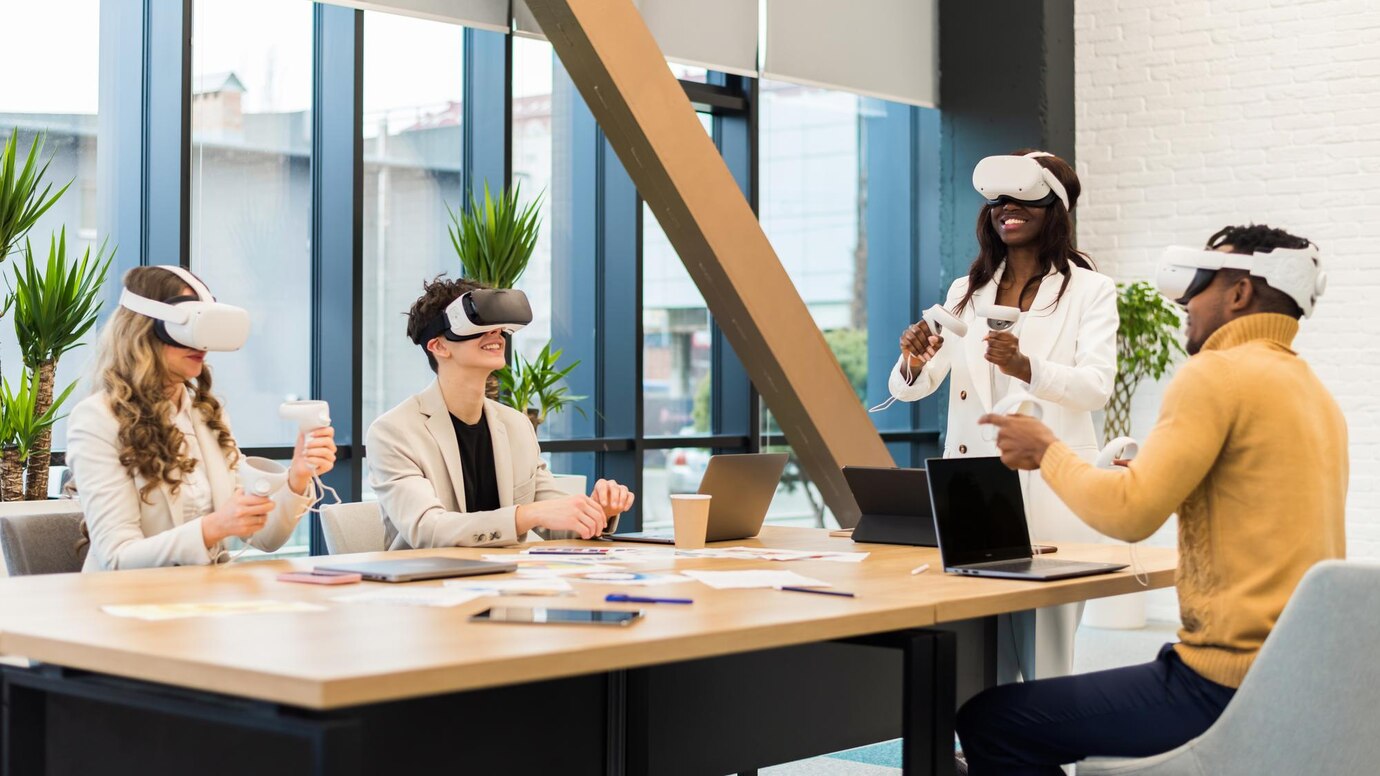
In 2026, the rectangular screen is no longer the primary window into the digital world. Spatial computing has fundamentally altered how we interact with information, effectively killing the traditional 2D desktop. Professionals now operate within a three-dimensional information landscape, using lightweight AR glasses or immersive VR environments to manipulate data with their hands and eyes. This transition from "looking at" a computer to "being inside" a workspace has revolutionized industries ranging from engineering to finance. Complex data sets are visualized as interactive landscapes that can be walked through, and remote teams collaborate as if they are standing in the same room, with life-sized avatars that convey subtle body language and eye contact.
This shift to spatial work has solved the isolation problems that characterized the early remote work era. Even when employees are thousands of miles apart, the "spatial office" provides a sense of presence and shared energy. Meeting rooms are now persistent digital spaces where brainstorms remain pinned to virtual walls indefinitely. The physical office has become a "docking station" for this digital layer, where employees come together to overlay their virtual worlds onto the physical environment. In 2026, the workplace is a hybrid reality where the digital and physical are indistinguishable, allowing for a level of creative expression and collaborative speed that was previously restricted by the flat limitations of legacy hardware.
The Hyper-Personalized Employee Experience
Standardization is a relic of the past in the 2026 workplace. Technology has enabled the hyper-personalization of the employee experience, ensuring that the work environment, schedule, and learning path are tailored to the unique biological and cognitive profile of every individual. AI-driven HR platforms now use predictive analytics to understand when an employee is most productive, automatically scheduling high-stakes meetings during their peak focus hours and suggesting restorative breaks during their natural lulls. This level of care extends to professional development, with AI tutors creating custom curriculums that evolve in real-time based on the employee's performance and career aspirations.
This personalization is the key to talent retention in a hyper-competitive market. Employees no longer have to fit themselves into a corporate mold; instead, the corporate environment shapes itself around them. We see this in the "Flex-Presence" model, where technology determines the optimal mix of remote and in-person work based on the specific tasks at hand and the psychological needs of the team. In 2026, the workplace is an empathetic entity that recognizes individual diversity as a source of strength. By leveraging data to serve the human, organizations are fostering a culture of profound loyalty and engagement, proving that the most advanced technology is that which makes us feel most understood as individuals.
Algorithmic Management and the Future of Leadership
The role of the manager is undergoing a radical transformation due to the rise of algorithmic management. In 2026, the administrative and logistical aspects of leadership—such as task assignment, performance tracking, and resource allocation—are handled by sophisticated algorithms. These systems provide a level of objective fairness that was often missing from human-led management, using real-time data to ensure that workloads are balanced and contributions are recognized without bias. This shift allows human leaders to move away from "micro-management" and focus on the qualities that machines cannot replicate: empathy, vision, mentorship, and high-level ethics.
Leadership in 2026 is about "Emotional Intelligence at Scale." While the algorithm handles the "what" and the "how," the human leader defines the "why." Leaders are now responsible for curating the corporate culture and ensuring that the human-AI partnership remains healthy and ethical. This transition has led to a more horizontal organizational structure, where authority is based on expertise and influence rather than hierarchy. Technology has stripped away the layers of bureaucracy that once slowed down large enterprises, resulting in a more agile and responsive leadership model. In 2026, the best managers are those who can navigate the data provided by the algorithm while maintaining a deep, personal connection with their teams.
Biometric Wellness and the Quantified Professional
Workplace wellness in 2026 has moved from a perk to a core operational strategy, powered by the rise of the quantified professional. Wearable and ambient biometric sensors now provide employees with real-time feedback on their stress levels, hydration, and cognitive load. This data is not used for surveillance, but for empowerment, allowing individuals to manage their energy with surgical precision. Companies have integrated these wellness streams into their digital platforms, automatically suggesting "micro-meditations" or desk-based exercises when the sensors detect rising tension. This proactive approach to health has drastically reduced burnout and absenteeism, creating a more resilient and sustainable workforce.
The 2026 office environment itself is bio-reactive. Air filtration systems adjust the oxygen and CO2 levels based on the number of people in a room to maintain mental clarity, while lighting follows the circadian rhythms of the occupants to ensure better sleep cycles. This focus on "Biophilic Integration" means that workplaces are increasingly filled with natural elements—automated indoor gardens and water features—that are maintained by the sentient building system. By treating the employee's biology as a critical asset, organizations are realizing that high performance is an outcome of high wellbeing. In 2026, the workplace is a sanctuary for health, proving that technological advancement can lead to a more humane and revitalizing work life.
The Decentralized Talent Cloud and Borderless Collaboration
The geographic boundaries of the workplace have effectively dissolved in 2026, replaced by the decentralized talent cloud. Technology has enabled a "Work-from-Anywhere" infrastructure that is secure, fast, and culturally cohesive. Global companies now operate as borderless entities, tapping into a fluid pool of talent that is not restricted by time zones or national borders. This is made possible by real-time AI translation and cultural mediation tools that allow for seamless communication across dozens of languages. In 2026, a team meeting can include members from five continents, all speaking their native tongues while hearing the others in perfectly translated, natural-sounding voices.
This borderless model has led to a new social contract between employers and employees. The "Talent Cloud" allows individuals to build "portfolio careers," working on multiple projects for different organizations simultaneously through decentralized platforms. Blockchain-based smart contracts handle payments and benefits instantly, providing security and transparency for a global gig economy. The physical office in this world acts as a "cultural embassy"—a place where the community occasionally gathers to reinforce social bonds and shared purpose. In 2026, the workplace is no longer a location; it is a global network of talent, empowered by technology to collaborate on a scale that was previously restricted by the physical limits of travel and language.
Predictive Maintenance for Human Productivity
One of the most innovative applications of AI in the 2026 workplace is the concept of predictive maintenance for human productivity. Just as industrial sensors predict when a machine is about to fail, workplace AI now identifies the early signs of "cognitive friction" or "team misalignment" before they become problems. By analyzing communication patterns, project velocity, and sentiment data, the AI can flag when a team is reaching a point of diminishing returns. It might suggest a change in project direction, a day of rest, or a specific intervention to resolve a budding conflict. This allows organizations to stay in a state of "High-Flow," avoiding the plateaus and crashes that were once common in high-pressure environments.
This predictive capability also applies to the physical workspace. AI agents manage the lifecycle of hardware and software, upgrading systems and repairing faults during off-hours so that the workday is never interrupted by technical failure. The goal is "Zero-Friction Work," where the tools and the environment are always in an optimal state. In 2026, we have moved from a reactive mode of solving problems to a proactive mode of preventing them. This has created a sense of psychological safety among the workforce, as employees know they are supported by a system that is designed to remove every obstacle from their path to success. Technology has become the ultimate enabler of the human potential.
The Ethics of the Digital Panopticon
As the workplace becomes increasingly data-driven, the ethical challenge of the "Digital Panopticon" has become the central debate of 2026. The same sensors and AI that provide wellness and productivity benefits can also be used for intrusive surveillance and control. To combat this, a new era of "Data Sovereignty for Employees" has emerged. Leading organizations now operate under strict ethical charters that ensure all workplace data is anonymized, encrypted, and owned by the individual. Employees have the right to "opt-out" of data collection without professional penalty, and AI systems are audited regularly for bias and transparency.
The focus of 2026 is on building trust through transparency. Companies that use data to manipulate or micro-manage their employees find themselves facing massive talent exits and legal repercussions. The "Chief Ethics Officer" is now one of the most critical roles in the C-suite, responsible for ensuring that the technological power of the organization is balanced with the fundamental rights of the workforce. In 2026, the most successful workplaces are those that have established a clear boundary between "helpful intelligence" and "intrusive oversight." By prioritizing privacy and human dignity, these organizations are proving that a data-rich workplace can still be a place of freedom and trust. Ethics is the new competitive advantage.
Conclusion: Engineering a Human-Centric Future
In conclusion, the technological revolution of the workplace in 2026 is not about replacing the human element, but about amplifying it. We have built an environment where sentient infrastructure, agentic AI, and spatial computing work in harmony to remove the limitations of the past. The workplace has evolved into a responsive, empathetic, and borderless ecosystem that prioritizes the health and potential of the individual. While the challenges of privacy and algorithmic management remain, the overall trajectory is one toward a more humane and fulfilling work life. We are finally using technology to build a world of work that fits the human spirit, rather than forcing the human spirit to fit the machine.
As we look forward, the success of any organization will depend on its ability to navigate this hybrid reality with wisdom and integrity. The tools of 2026—from biometric sensors to the decentralized talent cloud—provide us with unprecedented power to create value and solve global problems. However, the true measure of our progress will be how well we use these tools to foster connection, purpose, and wellbeing. The future of work is not just digital; it is profoundly human. By engineering a workplace that is intelligent, inclusive, and ethical, we are not just changing how we work; we are changing how we live. The architecture of the future is here, and it is ours to lead.
References
Microsoft Work Trend Index: microsoft.com/worklab
MIT Technology Review: technologyreview.com
World Economic Forum Future of Jobs: weforum.org
HBR Future of Work: hbr.org
Forbes Tech Council: forbes.com
Popular posts
-
How Robotics Will Transform FactoriesTech Blog • 508 views
-
Future Smartphones: What’s Coming NextTech Blog • 492 views
-
How AI Is Transforming Business in 2025Tech Blog • 480 views
-
Future of Online SecurityTech Blog • 453 views
-
Best Coding Languages for 2025Tech Blog • 449 views