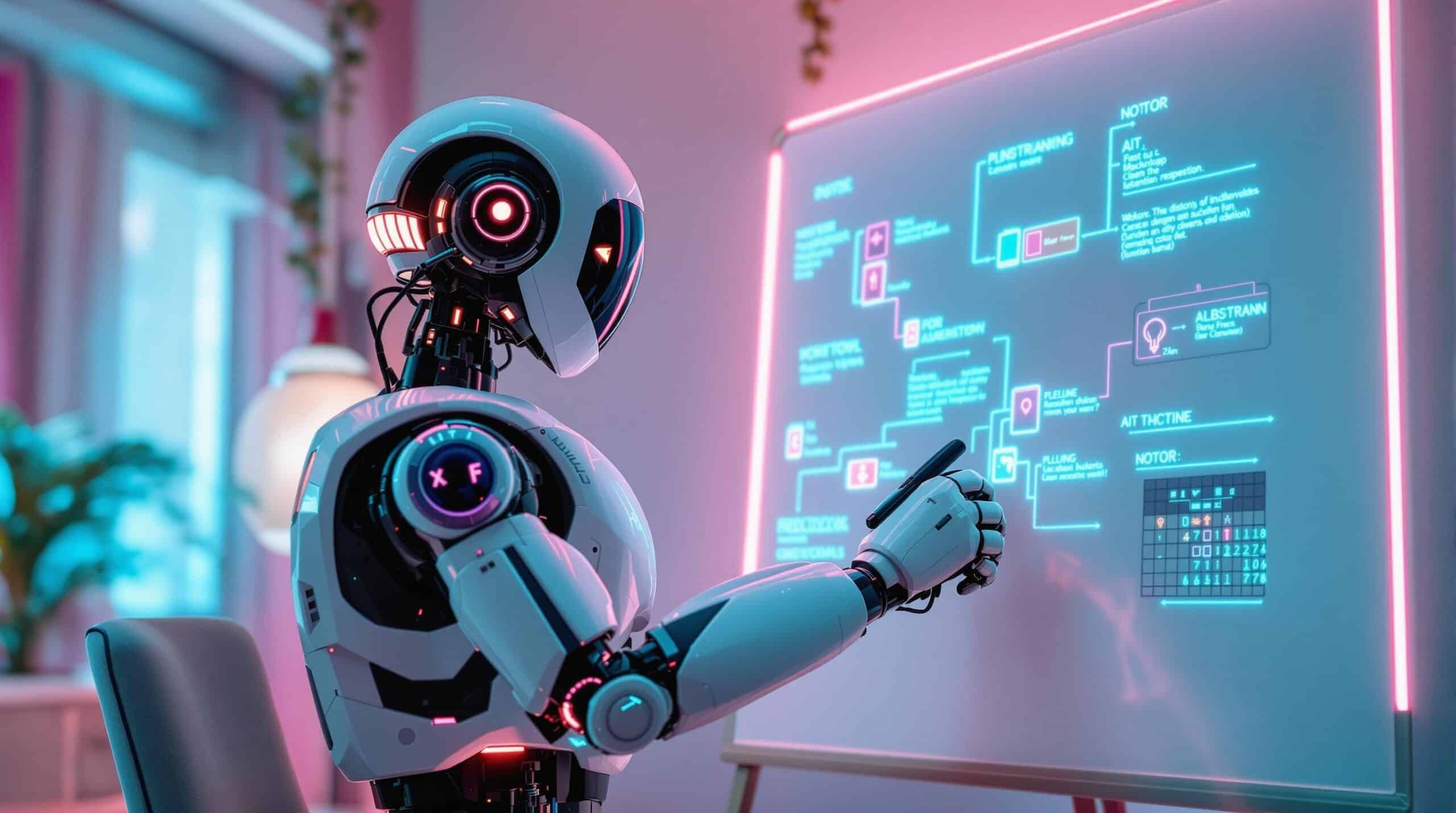
How AI Improves Productivity
Created on 2 January, 2026 • Tech Blog • 353 views • 9 minutes read
How AI improves productivity in 2026: Discover the impact of Agentic AI, multi-agent collaboration, and AI-native workflows on the modern workforce.
How AI Improves Productivity: The Collaborative Frontier of 2026
Table of Contents
- The Shift from Automation to Augmentation
- Agentic Workflows: AI as an Autonomous Teammate
- Hyper-Efficiency in Software Development and IT
- The Multi-Agent Ecosystem: Orchestrating Complex Business Processes
- Revolutionizing Scientific Research and R&D
- Data Synthesis and Real-Time Decision Support
- The Impact on Human Creativity and High-Value Strategy
- Micro-Productivity: Saving Hours in the Daily Grind
- The "Competence Trust" Benchmark: Overcoming Adoption Hurdles
- Conclusion: The Rise of the Human-AI Hybrid Workforce
The Shift from Automation to Augmentation
As we enter 2026, the narrative surrounding Artificial Intelligence has fundamentally changed. We have moved past the initial fear of mass replacement and into the era of "Human Amplification." In 2025, we saw the rapid adoption of generative tools, but 2026 is the year these tools have become deeply woven into the fabric of global commerce. Productivity is no longer measured solely by how many tasks a machine can do without us, but by how much more a human can achieve when paired with a sophisticated AI partner. This shift allows small teams to operate with the industrial impact of massive organizations, effectively flattening traditional corporate hierarchies.
The core of this productivity boom lies in the removal of "cognitive load." Modern AI systems in 2026 handle the dense data processing, content summarization, and routine workflow orchestration that previously consumed up to 60 percent of a knowledge worker's day. By offloading these low-value but high-effort tasks, professionals are experiencing a "Productivity Quadrupling" in industries most exposed to AI. The goal of technology has evolved from simply making us faster to making us smarter—helping us uncover blind spots in our thinking and challenging our assumptions with data-driven insights in real-time.
Agentic Workflows: AI as an Autonomous Teammate
One of the most transformative features of 2026 is the rise of Agentic AI. Unlike the "chatbot" era of 2023, where AI responded to single prompts, agentic workflows involve autonomous systems that can reason, plan, and execute multi-step goals with minimal human oversight. These agents don't just write a draft; they research the topic, check for compliance, find relevant images, and schedule the final post. This transition from "tool" to "teammate" is saving employees an average of 40 minutes per interaction by eliminating the need for constant back-and-forth prompting.
In 2026, enterprises are reporting a 66 percent increase in throughput by deploying these agents into specific business functions. For example, in customer service, AI agents can now resolve complex issues, manage returns, and initiate transactions autonomously, leaving only the most sensitive relationship-based cases for human representatives. This "agent-first" service model ensures that internal operational bottlenecks are eliminated, allowing the business to scale without a linear increase in headcount. Productivity is thus redefined as the ability to maintain a continuous, 24/7 operational rhythm through autonomous execution.
Hyper-Efficiency in Software Development and IT
The software engineering landscape in 2026 has become the gold standard for AI-driven productivity. AI is no longer just a "copilot" for writing code snippets; it is an architect that understands the entire context of a repository. Modern AI tools can now automatically detect errors earlier in the development cycle, suggest architectural improvements, and even automate routine security patches. This has resulted in a massive reduction in "technical debt" and has allowed developers to focus on high-level system design rather than mundane debugging.
Beyond coding, IT operations are being managed by "Orchestration Layers" that dynamically route computing power. If one server job slows down, AI instantly moves the workload to ensure no cycle or watt is wasted. This "Air Traffic Control" for computing has led to significantly faster software delivery cycles. By late 2025, organizations reported that their developers were able to double their output of new features while simultaneously improving the stability of their legacy systems. In the world of 2026, the bottleneck is no longer the speed of the keyboard, but the clarity of the logic provided by the human architect.
The Multi-Agent Ecosystem: Orchestrating Complex Business Processes
A major productivity breakthrough in 2026 is Multi-Agent Collaboration. Businesses are now utilizing ecosystems where different AI agents coordinate like a specialized human team. For instance, in a supply chain context, a "Sales Agent" might negotiate a quote, a "Finance Agent" validates the profit margins, an "Inventory Agent" checks current stock levels, and a "Fulfillment Agent" triggers the shipping allocation. This entire chain happens in seconds, governed by strict rules and audit logs to ensure human-level accountability without human-level delays.
This "Orchestrated Workforce" model mirrors human organizational structures but operates at a thousand times the speed. It allows for "Hyper-Personalization at Scale," where every customer journey is tailored by an agent ecosystem working in the background. In 2026, mid-sized firms are using these protocols to compete with global conglomerates, leveraging their agility and AI-native workflows to respond to market changes instantly. Productivity in this context is the ability to turn a complex, multi-departmental process into a single, seamless, and automated event.
Revolutionizing Scientific Research and R&D
In the fields of science and pharmaceuticals, AI has shifted from being a supportive analytical tool to a core driver of discovery. In 2026, researchers are using "Scientific Workflows" where AI agents execute massive simulations and interpret experimental data. This reduces the manual analytical workload by up to 90 percent, allowing experts to spend their time guiding the AI-driven exploration rather than performing repetitive laboratory tasks. This has been particularly evident in the discovery of new materials and the archeology of high-performing neural nets for protein folding.
The speed of innovation in R&D has accelerated because AI can now find patterns in data that were previously invisible to human eyes. Hybrid computing models—where quantum computers work alongside AI—are solving society's toughest challenges, such as optimizing carbon capture materials or designing new battery chemistries. By late 2025, the time required for a query in large industrial datasets was reduced by 95 percent in companies that fully integrated Gemini-level agents. This acceleration of the "Idea-to-Market" cycle is perhaps the most significant long-term productivity gain afforded by AI.
Data Synthesis and Real-Time Decision Support
In 2026, the biggest drain on productivity—information overload—has been neutralized. AI systems now act as real-time intelligence hubs that synthesize vast amounts of data into actionable insights. For a C-suite executive or a manager, this means no longer waiting for weekly reports. AI agents monitor geopolitical risks, compliance updates, and competitor movements, providing a "Strategic Dashboard" that highlights the most critical trade-offs for a decision. This "Competence Trust" allows leaders to move with a level of confidence and speed that was impossible in the pre-AI era.
This real-time decision support extends to the frontline as well. In retail and hospitality, AI agents analyze crowd flows and predict demand spikes, orchestrating staff allocation on the fly to reduce friction and improve the customer experience. By 2026, organizations are using these systems to flatten their structures, eliminating the need for layers of middle management whose primary job was previously the manual synthesis of data. Productivity is now found in the "Decision Velocity"—the speed at which a company can identify a challenge and execute a solution.
The Impact on Human Creativity and High-Value Strategy
A common misconception was that AI would kill creativity; in 2026, it has done the opposite by removing the "drudgery" of the creative process. Designers and writers are using AI to generate dozens of iterations in seconds, allowing them to focus their energy on the final 10 percent of "human touch" that defines a brand's soul. Small three-person creative teams are now launching global marketing campaigns in days, with AI handling the data crunching and content personalization while humans steer the emotional strategy and high-level vision.
This "Human-Centric" productivity model values creative thinking, leadership, and resilience over technical fluency. As AI handles the "how," humans are being asked to focus more deeply on the "why." By 2026, the most productive workers are those who have mastered "Hybrid Skill Sets"—the ability to combine deep domain expertise with the technical skill to steer AI agents. This elevation of the human role has led to higher job satisfaction in sectors where workers feel empowered to innovate rather than just "keep up" with a mounting pile of tasks.
Micro-Productivity: Saving Hours in the Daily Grind
On an individual level, AI's impact on productivity is seen in the "Micro-Moments." Research in late 2025 shows that regular AI users are saving an average of 12 hours per week. This time is recouped through automated scheduling, instant email drafting, and real-time summarization of long meetings. Professionals no longer spend hours "looking for that one document"; AI agents with large context windows can recall and synthesize information from a year's worth of conversations and files in seconds. This is the "End of Digital Friction."
In 2026, we are also seeing the rise of "Personal AI Concierges" that manage an individual's professional life. These agents handle travel bookings, expense reporting, and task prioritization based on the user's goals. This allows employees to stay in a "Flow State" for longer periods, significantly increasing the quality of their deep work. For a standard 40-hour work week, this 5.4 percent gain in time-saving translates to nearly half a day returned to the employee for either higher-value projects or better work-life balance. Micro-productivity gains are the foundation of the 2026 "Efficiency Boom."
The "Competence Trust" Benchmark: Overcoming Adoption Hurdles
Despite the technological leaps, productivity in 2026 is still governed by the "Trust Factor." Companies have learned that AI only improves productivity if employees trust the accuracy of the output. This "Competence Trust" is the primary benchmark for AI success. If an agent hallucinates a fact, the user will spend more time double-checking its work than they saved by using it. To solve this, 2026 has seen a surge in "Testing and Monitoring" solutions that allow businesses to benchmark AI performance and identify exactly where it is providing value.
Education and training have also become mandatory for productivity. Workers who receive more than five hours of AI training and have access to in-person coaching report significantly higher usage rates and better outcomes. In late 2025, the wage premium for AI-proficient workers reached 56 percent, reflecting the immense value they bring to an organization. Organizations that focus on "Mindset Transformation"—reframing AI as a collaborative partner rather than a competitor—are seeing 2.5 times higher revenue growth than those who simply "plug and play" the technology without cultural integration.
Conclusion: The Rise of the Human-AI Hybrid Workforce
In conclusion, the story of how AI improves productivity in 2026 is a story of partnership. By automating the routine, orchestrating the complex, and amplifying the creative, AI has allowed the global workforce to reach a new level of efficiency. We are no longer limited by the number of hours in a day, but by the depth of our questions and the precision of our strategic intent. The shift to an "Agentic Enterprise" has proven that the most successful organizations are those that design their workflows around people and AI working in tandem.
As we look toward the 2030s, the productivity revolution will only accelerate as AI becomes more integrated with quantum computing and IoT data. The future belongs to the "Orchestrators"—the individuals and companies that can lead teams of both humans and agents toward a shared vision. Productivity is no longer a measure of human sweat, but a measure of human-AI synergy. In 2026, we have finally built the tools that don't just work *for* us, but *with* us, unlocking a future of unprecedented prosperity and potential. The transition is challenging, but the result is a world where we can finally focus on solving our biggest problems while AI handles the rest.
References
What's Next in AI: 7 Trends to Watch in 2026 (Microsoft) |
5 Ways AI Agents Will Transform the Way We Work in 2026 (Google Blog) |
2026 AI Trends: What Leaders Need to Know (IMD Business School) |
2026 AI Business Predictions (PwC)
Popular posts
-
How Robotics Will Transform FactoriesTech Blog • 508 views
-
Future Smartphones: What’s Coming NextTech Blog • 492 views
-
How AI Is Transforming Business in 2025Tech Blog • 480 views
-
Future of Online SecurityTech Blog • 453 views
-
Best Coding Languages for 2025Tech Blog • 449 views