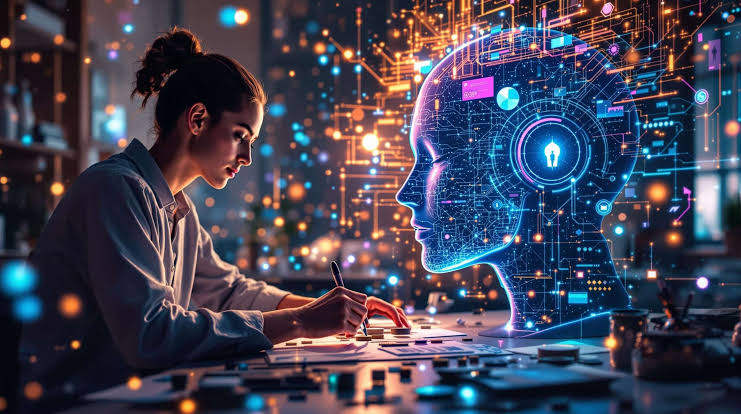
How AI Helps Creative Work
Created on 19 December, 2025 • Tech Blog • 399 views • 13 minutes read
Explore how AI helps creative work in 2025. Learn about the Orchestration Era, vibe coding, sonic innovation, and the return to handcrafted styles.
How AI Helps Creative Work
Table of Contents
- The Orchestration Era: From Production to Creative Direction
- The Ideation Catalyst: How AI Ends the Blank Page Syndrome
- Visual Synergy: Character Consistency and Multi-Tool AI Agents
- Sonic Frontiers: The Democratization of Music and Sound Design
- The Rise of Vibe Coding: App and Web Design via Natural Language
- Narrative Depth: AI as a World-Building and Structural Teammate
- Post-Production and Video: Automating the Mundane for Cinematic Freedom
- The Human Response: Balancing AI Efficiency with Handcrafted Authenticity
- Ethical Landscapes: Intellectual Property and the Value of Vision
- Conclusion: The Symbiotic Future of Human-AI Creative Partnerships
The Orchestration Era: From Production to Creative Direction
As we navigate the closing weeks of 2025, the role of the creative professional has undergone a fundamental transformation that rivals the introduction of the digital camera or the internet itself. We have moved decisively out of the era where AI was merely a novel curiosity and into what industry leaders call the Orchestration Era. In this new paradigm, the primary skill of a designer, writer, or filmmaker is no longer just the technical execution of a task but the high-level orchestration of multiple intelligent systems. Artificial intelligence has effectively commoditized the "how" of creation—the brushstrokes, the syntax, and the basic video cuts—allowing the human creator to focus almost entirely on the "why." This shift from production to creative direction means that a single individual can now oversee complex projects that previously required an entire agency, using AI to bridge the gap between a raw concept and a professional-grade final product.
The hallmark of this era is the realization that AI is not a replacement for talent but an expansive canvas for it. By handling the heavy lifting of data analysis, asset generation, and repetitive technical adjustments, AI acts as a central nervous system for the creative workflow. This allows for a much more fluid and modular approach to creativity, where ideas can evolve in real-time based on immediate feedback loops. For a marketing director in 2026, this might mean launching a global, multi-channel campaign in a matter of days rather than months, with AI tailoring every visual and text element to specific local audiences while the director ensures that the core brand story remains authentic and resonant. The creative craft is becoming less about the struggle with the tools and more about the clarity of the vision, marking the most significant expansion of creative potential in human history.
The Ideation Catalyst: How AI Ends the Blank Page Syndrome
One of the most immediate and profound ways AI helps creative work is by serving as the ultimate antidote to "blank page syndrome." For writers, designers, and artists, the initial stage of a project is often the most grueling, as they search for a starting point or a unique angle. In 2025, AI models like Claude and ChatGPT have evolved into sophisticated brainstorming partners that do not just provide generic answers but offer contextual, nuanced suggestions based on a user’s specific style or project history. By inputting a few rough thoughts or a mood board, a creator can instantly generate dozens of potential directions, sketches, or outlines. This doesn't mean the AI is doing the thinking; rather, it provides the "creative friction" necessary to spark the human brain into action, acting as a sounding board that is available twenty-four hours a day.
This ideation capability extends into "repository intelligence," where AI understands the history and relationships within a creator's past work. For a novelist, an AI might suggest how a new character's trait conflicts with a plot point established three hundred pages earlier, or for a graphic designer, it might suggest color palettes that complement a brand’s aesthetic from five years ago. This level of cognitive support allows creatives to explore the "multiverse" of their own ideas at a speed that was previously impossible. Instead of spending days on a single concept, they can iterate through hundreds of variations in a morning, selecting the most promising seeds to nurture into full-blown projects. By removing the fear of the empty canvas, AI has democratized the courage to create, making the act of beginning a project as accessible as having a conversation.
Visual Synergy: Character Consistency and Multi-Tool AI Agents
In the realm of visual arts and photography, 2025 has brought a solution to one of the most persistent hurdles in AI generation: character consistency. Early generative models struggled to maintain the same face, clothing, or environment across multiple images, which made them difficult to use for professional storytelling or long-form branding. Today, advanced tools allow artists to "lock in" specific visual identities, ensuring that a character in a children's book or a digital influencer in a fashion campaign remains perfectly recognizable across every frame, regardless of the angle or lighting. This breakthrough has opened the floodgates for independent creators to produce high-quality graphic novels, animated shorts, and consistent brand libraries that look and feel like they were produced by a high-end studio.
Furthermore, we are seeing the rise of "agentic workflows," where multiple AI tools work in tandem to complete a visual task. A designer might use one AI to generate a structural layout, a second to handle the specific textures of a 3D model, and a third to optimize the lighting for a cinematic feel, all orchestrated through a single interface. This synergy allows for "2D and 3D merges" that were previously the domain of specialized VFX houses. Because these AI agents can communicate with each other, they can ensure that a change made in one part of the project—such as moving a light source—is reflected across all assets automatically. This level of technical automation ensures that the visual artist is never bogged down by the "mechanics" of the software, allowing them to remain in a state of flow where they can experiment with bold new aesthetics without the penalty of time-consuming rework.
Sonic Frontiers: The Democratization of Music and Sound Design
Music production and sound design have been revolutionized by AI’s ability to act as both an instrument and an engineer. In 2025, generative audio models have matured to the point where they can assist musicians in creating complex background scores, generating unique melodies, and even mimicking the specific "warmth" of vintage analog equipment. For independent filmmakers and game developers, this means the ability to produce high-fidelity, adaptive soundtracks that react in real-time to the player’s actions or the emotional beats of a scene. AI-driven stem separation has also become a standard tool, allowing producers to isolate individual instruments from older recordings with near-perfect clarity, opening up new worlds for remixing, sampling, and historical preservation.
Beyond composition, AI is handling the more technical aspects of the sonic craft, such as mixing and mastering. Smart plugins can now analyze a track and suggest EQ balances, compression levels, and spatial positioning that match the professional standards of specific genres. This doesn't replace the "golden ear" of a human producer, but it provides a professional-grade baseline that allows musicians with limited budgets to release work that sounds competitive on global streaming platforms. Additionally, AI is being used for "voice synthesis" in voice-over work, allowing creators to generate realistic narrations in hundreds of languages and dialects while maintaining the emotional nuance of the original performance. This democratization of high-end sound ensures that the "sonic moat" that once protected major labels and studios is disappearing, replaced by an ecosystem where the quality of the song or the story is the only true differentiator.
The Rise of Vibe Coding: App and Web Design via Natural Language
One of the most exciting trends for 2026 is what industry insiders call "vibe coding." This refers to the ability to build functional applications and websites by simply describing the "vibe" or intent of the project to an AI, rather than writing lines of code manually. This represents a massive shift for UI/UX designers who may have had brilliant ideas for digital products but lacked the technical background to bring them to life. By using natural language prompts, a designer can now describe the user journey, the aesthetic feel, and the desired functionality, and the AI generates the underlying architecture, frontend code, and even the necessary backend integrations in a matter of seconds.
This "natural language development" allows for rapid prototyping at a scale never seen before. A design team can build and test five different versions of a mobile app in a single afternoon, gathering real user data on which "vibe" performs the best. This effectively turns the designer into a product manager, where their value lies in their understanding of human psychology and user experience rather than their ability to debug a script. As these AI tools become more integrated into platforms like Figma and Canva, the line between "designing" and "building" is blurring into a single, unified creative act. This empowerment of the "non-technical" creator is leading to a surge in niche, hyper-personalized digital tools that are built to solve specific community problems that larger tech companies might overlook.
Narrative Depth: AI as a World-Building and Structural Teammate
In the world of literature and professional writing, AI has moved beyond being a simple grammar checker and into the role of a structural teammate. Contemporary authors are using AI to manage the immense complexity of "world-building," especially in genres like fantasy and science fiction where internal consistency is paramount. AI can act as a living encyclopedia for a fictional world, keeping track of family lineages, geographical distances, and the specific rules of a magic or technology system. When an author is deep in the "mid-draft slump," they can ask the AI to suggest three different ways a specific conflict might be resolved based on the established character motivations, providing a spark that keeps the creative momentum moving forward.
Furthermore, AI is helping writers bridge the gap between their creative vision and the commercial reality of the publishing industry. Tools can now analyze a manuscript to provide insights on pacing, emotional resonance, and even potential market fit, helping authors refine their work before it ever reaches an agent's desk. In journalism and technical writing, AI is being used to synthesize vast amounts of research into coherent summaries, allowing writers to focus on the "storytelling" and the "human impact" rather than the tedious process of manual fact-checking. This partnership allows for a more "modular" approach to writing, where the AI handles the data-heavy or repetitive sections, freeing the human writer to infuse the work with the personal stories, emotional nuances, and cultural insights that only a human can provide.
Post-Production and Video: Automating the Mundane for Cinematic Freedom
The film and video industry is perhaps the most visible beneficiary of AI's rapid improvement. In 2025, tools like Sora 2, Kling AI, and Runway have turned post-production from a bottleneck into a playground. Tasks that used to take weeks of painstaking manual labor—such as rotoscoping, color grading, and object removal—can now be completed in minutes with a few text commands. AI can now "extend" a shot by generating what would have been outside the original camera frame or "de-age" an actor with a level of realism that was previously only available to multi-million dollar Marvel-style productions. This allows independent filmmakers to achieve a "big budget" look on a fraction of the cost, leveling the playing field for storytellers around the world.
Crucially, AI is also being used in the pre-production phase to help directors visualize their projects. "AI Storyboarding" allows a director to generate high-fidelity frames for every scene in their script, making it much easier to communicate their vision to the crew and potential investors. In the editing room, AI can analyze hours of raw footage to find the best takes based on lighting, focus, and even the emotional intensity of the performance, providing the editor with a "first cut" that they can then refine and polish. By automating the mundane aspects of filmmaking, AI is releasing directors and editors to spend more time on the subtle art of timing, rhythm, and narrative structure, ensuring that the "soul" of the movie remains a purely human creation.
The Human Response: Balancing AI Efficiency with Handcrafted Authenticity
As AI-generated content becomes more prevalent, we are seeing a fascinating counter-trend: a renewed and intense valuation of "handcrafted" and "authentic" work. In 2026, the most successful creatives are those who understand how to balance the hyper-efficiency of AI with the unique "imperfections" that signal human touch. Industry experts predict a massive return to traditional art forms, such as hand-printed woodblocks, oil painting, and physical sketching, as a way for artists to stand out in a market saturated with "perfect" digital imagery. This "Anti-AI" movement is not necessarily about rejecting the technology entirely, but about using it as a back-end tool while ensuring the final output retains the emotional weight and physical presence of a human-made object.
This desire for authenticity is also driving a shift in branding and social media aesthetics. Audiences are increasingly wary of "too-perfect" AI visuals and are gravitating toward content that feels raw, emotional, and lived-in. Successful creatives are responding by using AI to handle their operational tasks—like scheduling and basic asset resizing—while doubling down on the "human-only" parts of their craft, such as original storytelling, deep empathy, and the ability to capture a specific cultural moment. The creative professional of the future is not just an expert in "prompt engineering" but an expert in "human resonance," knowing exactly when to use a machine for speed and when to use their own hands for soul. This balance is creating a "new craft" that blends the best of both worlds, where the speed of the future supports the timelessness of the human spirit.
Ethical Landscapes: Intellectual Property and the Value of Vision
The rise of AI in creative work has brought significant legal and ethical challenges that are still being resolved as we enter 2026. The question of "who owns an AI-generated image" or "whether training data infringes on copyright" remains at the forefront of the industry's consciousness. Creative leaders are increasingly advocating for "transparent AI," where models are trained on licensed datasets and creators are compensated for the use of their work in the training process. This shift is leading to the emergence of "ethical AI" platforms that provide creators with peace of mind, ensuring that the tools they use to enhance their work do not inadvertently devalue the work of their peers. For the individual creator, this means a greater emphasis on "vision" and "provenance"—the story of how a piece was made and the human decisions that guided it.
As technical firepower becomes a commodity, the true "moat" for a creative business is shifting from the ability to "do the work" to the ability to "provide the strategy and the relationship." Clients are no longer paying for the hours spent pushing pixels or writing copy; they are paying for the human judgment, the deep understanding of their brand's purpose, and the ethical responsibility that a machine cannot provide. This is forcing a re-evaluation of the economics of creativity, where "output" is cheap but "outcome" and "originality" are more expensive than ever. By navigating these ethical waters with transparency and integrity, creators can use AI to amplify their work without losing the trust of their audience or the legal protection of their ideas, ensuring that the value of human vision remains the primary currency of the creative economy.
Conclusion: The Symbiotic Future of Human-AI Creative Partnerships
In conclusion, the impact of AI on creative work is not a story of replacement, but one of unprecedented empowerment and evolution. By acting as a tireless brainstormer, a technical optimizer, and a bridge between disciplines, AI is allowing humans to reach higher levels of creative expression than ever before. We are entering an era of "symbiotic creativity," where the machine handles the vast, the repetitive, and the technical, while the human provides the purpose, the emotion, and the cultural context. The rapid improvement of these tools has ensured that the only limit to what can be created is no longer the budget or the technical skill, but the depth of the creator's imagination. As we look toward 2026, the most successful creatives will be those who embrace this partnership with curiosity and a clear sense of their own humanity, using AI to build a world that is not just more efficient, but more beautiful, diverse, and profoundly connected. The journey from "production" to "orchestration" is complete, and the stage is set for a new golden age of human creativity supported by the most powerful tools ever conceived.
References
What's Next in AI: 7 Trends for 2026 (Microsoft) |
AI Trend Report 2026: The Creative Shift (Artlist) |
Surprising Creative Trends for 2026 (Creative Boom)
Popular posts
-
How Robotics Will Transform FactoriesTech Blog • 508 views
-
Future Smartphones: What’s Coming NextTech Blog • 492 views
-
How AI Is Transforming Business in 2025Tech Blog • 480 views
-
Future of Online SecurityTech Blog • 453 views
-
Best Coding Languages for 2025Tech Blog • 449 views