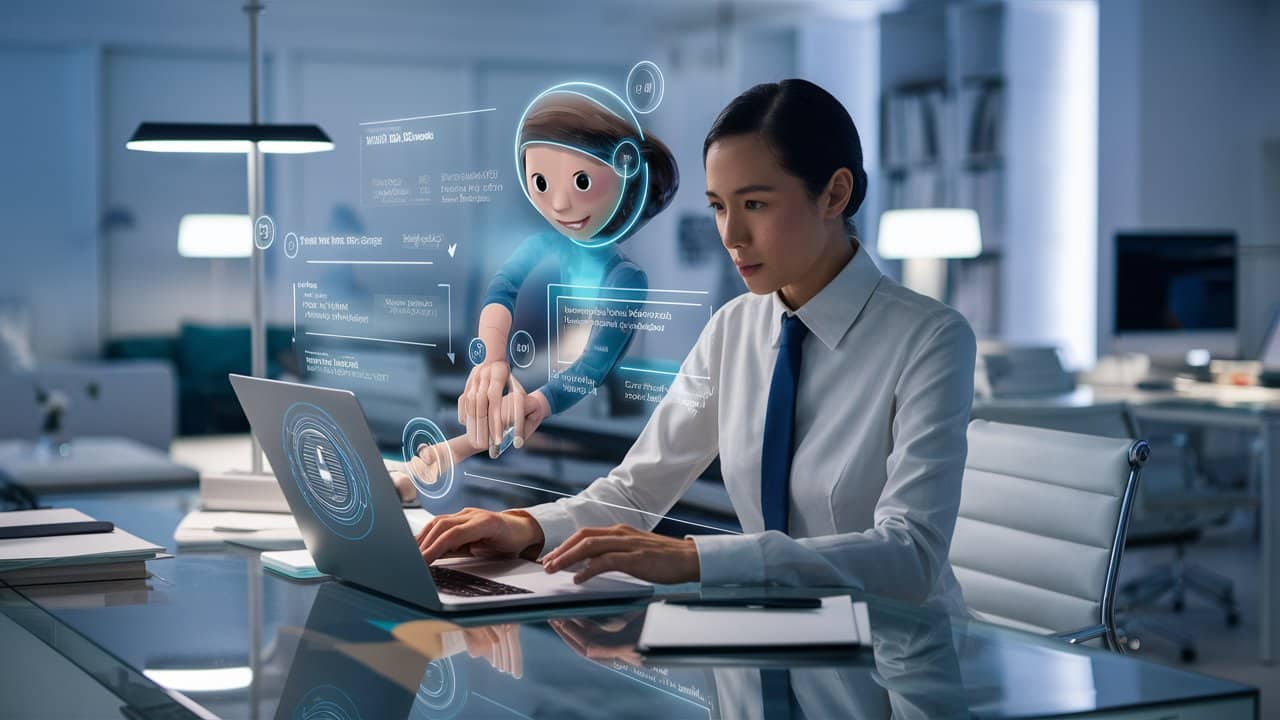
AI Assistants Getting Smarter
Created on 27 December, 2025 • Tech Blog • 330 views • 9 minutes read
Explore how AI assistants are getting smarter in 2026: From Agentic AI and multimodality to long-term memory and autonomous physical-world integration.
AI Assistants Getting Smarter: The Transition to Agentic Autonomy in 2026
Table of Contents
- The Great Evolution: From Chatbots to Autonomous AI Agents
- Agentic Workflows: The Power of Multi-Step Reasoning
- Multimodality: Assistants That See, Hear, and Sense the World
- The Rise of Personalization and Long-Term Contextual Memory
- Small Language Models (SLMs) and the Move to the Edge
- AI in the Physical World: Robotics and IoT Integration
- The Specter of Deepfakes: Authenticity and Trust as Benchmarks
- Business Impact: Redefining Productivity and the Digital Workforce
- The Safety Frontier: Managing Non-Human Identities (NHIs)
- Conclusion: Toward a Seamless Human-AI Collaborative Future
The Great Evolution: From Chatbots to Autonomous AI Agents
As we navigate through the final weeks of 2025, the narrative surrounding artificial intelligence is shifting from "What can AI say?" to "What can AI do?" We are currently witnessing the end of the traditional chatbot era. In late 2025, the industry has pivoted toward Agentic AI—systems that do not just respond to prompts but autonomously plan, execute, and monitor multi-step workflows to achieve a specific goal. While a chatbot acts like a passive encyclopedia, an AI agent acts like a digital employee with a laptop and a mission. This transition marks the most significant leap in intelligence since the launch of ChatGPT in late 2022.
By 2026, the baseline for a "smart" assistant is its ability to operate with minimal human oversight. Gartner predicts that by mid-2026, AI agents will manage roughly 40% of business applications. This shift is driven by a move from reactive interactions—where the user must provide a perfect prompt—to proactive ones, where the assistant anticipates a need based on previous behavior and current context. The assistant of 2026 doesn't wait for you to ask for a flight; it notices a meeting invite on your calendar, checks your travel preferences, and presents you with three fully vetted options, including ground transport, before you even open your browser.
Agentic Workflows: The Power of Multi-Step Reasoning
The core of this new intelligence lies in "Agentic Workflows." In the past, if an AI encountered a complex problem, it would provide its best guess in a single shot. In late 2025, smarter assistants use Chain-of-Thought (CoT) reasoning. They break a goal down into a series of smaller, manageable tasks, much like a human project manager. If you tell an agent to "organize a team offsite," it identifies the sub-tasks: polling the team for dates, researching venues, checking the budget, and sending out calendar invites. It iterates on these steps, correcting itself if a venue is booked or a budget is exceeded.
This "closed-loop" system allows assistants to interact with external tools and APIs. Modern frameworks like LangChain and AutoGen have enabled agents to use "digital hands"—the ability to browse the web, edit spreadsheets, and send emails independently. This means the AI is no longer a silent partner; it is an active participant in the workflow. As we move into 2026, the focus for developers has shifted from making models "bigger" to making them "smarter" at tool-use and self-correction, resulting in a 30% increase in task completion accuracy compared to early-2025 systems.
Multimodality: Assistants That See, Hear, and Sense the World
In 2025, the sensory capabilities of AI assistants have reached a breakthrough point. We have moved beyond "text-in, text-out" models toward true multimodality. The smartest assistants now process text, images, voice, and even real-time video simultaneously. This allows for a much more natural form of human-computer interaction. You can hold your phone up to a broken dishwasher and ask, "How do I fix this?" The assistant will visually identify the model, detect the error code, and walk you through the repair using spatial audio and visual overlays.
This cross-modal reasoning is also transforming education and professional training. AI tutors can now monitor a student's facial expressions and gestures to detect confusion or boredom, adjusting their teaching style or providing a helpful visual aid in real-time. By early 2026, multimodal AI will be the default interface for most consumer devices, allowing users to communicate through a mix of speech, gestures, and visual cues. This "natural interaction" makes technology accessible to those who may struggle with traditional typing, effectively closing the digital divide for millions of users worldwide.
The Rise of Personalization and Long-Term Contextual Memory
The most frustrating limitation of early AI was its "amnesia"—the inability to remember who you were once the chat window was closed. In late 2025, this has been solved through Long-Term Contextual Memory. Smart assistants now maintain a persistent, secure "knowledge map" of their user. They understand your professional jargon, your family's dietary restrictions, and your long-term goals. This isn't just about storing data; it's about interpreting human context over time. If you say "Book a table at that place we liked," the assistant knows exactly which restaurant you mean because it remembers your conversation from six months ago.
This hyper-personalization is becoming the baseline for digital experience. Platforms no longer wait for a prompt; they anticipate needs by analyzing behavior patterns and environmental signals. If the assistant detects you are stressed (via wearable heart-rate data) and notices a gap in your schedule, it might suggest a 10-minute meditation or proactively reschedule a non-urgent meeting. In 2026, the "Segment of One" will be the primary target for all AI-driven services, ensuring that every digital interaction feels uniquely tailored to the individual's specific life and emotional state.
Small Language Models (SLMs) and the Move to the Edge
While massive models like GPT-5 and Gemini 2.0 define the ceiling of AI intelligence, 2025 has seen the rapid rise of Small Language Models (SLMs). These are highly optimized models designed to run locally on devices like smartphones, laptops, and even home appliances. Moving AI to the "edge" reduces latency, cuts down on expensive cloud compute costs, and—most importantly—drastically improves privacy. Your personal data never has to leave your device to be processed by a smart assistant.
By 2026, the performance gap between cloud-based giants and edge-based specialists is closing. Specialized SLMs are often faster and more accurate for specific tasks, such as coding or medical diagnostics, than their larger counterparts. This "local intelligence" allows for offline capabilities, meaning your smart assistant remains functional even without an internet connection. This move toward the edge is a critical step in making AI an ambient, invisible part of our daily lives, where intelligence is baked into the silicon of every device we own.
AI in the Physical World: Robotics and IoT Integration
One of the most profound shifts in late 2025 is the integration of AI agents with the physical world through Vision-Language-Action (VLA) models. Smart assistants are jumping out of the screen and into our homes and workplaces. An AI agent is no longer just a voice on your speaker; it is the brain for your autonomous cleaning robot or your smart home security system. These systems can perceive, navigate, and manipulate their environment with a level of common-sense reasoning that was previously impossible.
For example, a home assistant in 2026 can detect a spilled drink, identify the liquid, and direct a cleaning robot to use the appropriate setting, all while informing the user that they are low on paper towels. In industrial settings, these assistants are powering autonomous warehouses and predictive safety systems that can intervene to prevent an accident. By the end of 2026, "Physical AI" will be a multi-billion dollar market, as we move from digital automation to the autonomous operation of physical infrastructure.
The Specter of Deepfakes: Authenticity and Trust as Benchmarks
As AI assistants become more human-like, the industry is facing a "Synthetic Content Crisis." In 2025, the ability to generate hyper-realistic voice and video has made trust and authenticity the new benchmarks for success. Leading AI providers are now implementing "Watermarking" and "Verifiable Origin" protocols to ensure that users know when they are interacting with an AI. In late 2025, a model's success is no longer just measured by its speed or accuracy, but by its emotional fidelity—its ability to interpret nuance and situational cues without crossing into the "uncanny valley."
This focus on trust is driving a move toward "Responsible AI Governance." Users are increasingly demanding transparency regarding how their data is used to train assistants and what happens to their private memories. In 2026, the most successful AI assistants will be those that prioritize "Digital Sovereignty," allowing users to own their digital twin and control the "keys" to their personal information. The goal is to build a "Safe AI" ecosystem where the benefits of a smarter assistant do not come at the cost of personal integrity or social cohesion.
Business Impact: Redefining Productivity and the Digital Workforce
In the professional world, smart assistants are being rebranded as the "Digital Workforce." In late 2025, companies are moving beyond simple "copilots" toward Autonomous Multi-Agent Teams. These are networks of specialized agents that can collaborate to complete complex projects. For instance, a "Marketing Agent" might draft a campaign, while a "Data Agent" optimizes the target audience, and a "Finance Agent" manages the budget—all working together with minimal human intervention to increase operational efficiency by up to 40%.
This is fundamentally changing the "Future of Work." By 2026, routine tasks like list cleaning, reporting, and basic customer service will be almost entirely handled by AI agents. This frees human employees to focus on high-value tasks like creative problem-solving, strategic innovation, and deep client relationship management. However, this shift also requires a massive wave of "AI Literacy" training. Gartner predicts that by 2027, 75% of hiring processes will include testing for AI proficiency. The successful professional of 2026 is not someone who can work *instead* of AI, but someone who can effectively *orchestrate* it.
The Safety Frontier: Managing Non-Human Identities (NHIs)
As we give AI agents "hands" (the ability to click buttons and move money), the security stakes have escalated. In late 2025, we have seen the rise of Non-Human Identities (NHIs). Every AI agent now requires its own secure identity—complete with API keys, OAuth tokens, and limited permissions—to interact with other systems. Securing these digital identities is the new frontline of cybersecurity. If a chatbot makes a mistake, it writes a wrong sentence; if an agent makes a mistake, it could accidentally delete a database or make an unauthorized purchase.
Governance frameworks are being developed to manage "Behavioral Drift" and ensure that agents remain within their "Safety Guardrails." In 2026, businesses will rely on "Agentic Observability" tools to monitor what their AI agents are doing in real-time. This involves a shift toward "Secure by Design," where safety is baked into the model's reasoning rather than added as an afterthought. Protecting the perimeter is no longer just about firewalls; it's about ensuring that our autonomous digital assistants are acting as reliable and ethical representatives of their human owners.
Conclusion: Toward a Seamless Human-AI Collaborative Future
In conclusion, the rise of smarter AI assistants in 2025 and 2026 represents a structural transformation of our relationship with technology. We are moving from a world where we "use" computers to a world where we "collaborate" with them. The convergence of agentic autonomy, multimodality, and local intelligence is creating a digital environment that is proactive, intuitive, and deeply personalized. While the challenges of trust and security are significant, the potential for increased productivity and enhanced creativity is unprecedented.
As we look forward to 2026, the "AI Buzz" is wearing off, replaced by the practical, everyday reality of systems that actually understand us. The smartest assistants will be those that feel less like a tool and more like an extension of our own capabilities. Whether it is a home assistant managing your physical chores or a professional agent orchestrating your business growth, the era of the passive chatbot is over. The future is agentic, and it is a future where the boundary between human intent and digital action becomes virtually seamless. The journey from assistance to autonomy has truly begun.
References
What’s Next in AI: 7 Trends to Watch in 2026 (Microsoft) |
The Leap from Assistance to Autonomy in 2026 (iLink Digital) |
Why 2026 Will Be the Year the AI Buzz Wears Off (Forbes)
Popular posts
-
How Robotics Will Transform FactoriesTech Blog • 508 views
-
Future Smartphones: What’s Coming NextTech Blog • 492 views
-
How AI Is Transforming Business in 2025Tech Blog • 480 views
-
Future of Online SecurityTech Blog • 453 views
-
Best Coding Languages for 2025Tech Blog • 449 views